
You must know precisely what hydraulic hose fitting you want to purchase. You’ll be prepared and won’t experience any problems if you’ve noted all of these connectors someplace. And, you have to figure it out the old-fashioned way, which entails some observation and measurement if you’re not sure what kind of connector or fitting you need. So, go with us into this article as we expand on how to identify hydraulic fitting.

How to identify Hydraulic fitting Size
Everywhere in the world, industrial machinery and equipment are created and produced. The hydraulic systems employ various fittings and adapters, each with a unique sealing design and thread type. When equipment adjustments or repairs are required, it can be challenging and time-consuming to distinguish thread shapes from sealing methods since they all seem to look the same.
Maintaining secure, effective, and lucrative processes may be facilitated by quickly and accurately detecting threads. Selecting the proper replacement components for maintenance and repair requires knowledge of the appropriate thread. By choosing the incorrect component, the fitting or adapter’s ability to withstand pressure and maintain a reliable seal may be compromised during installation.
The most popular and extensively used hydraulic fittings are explained here;
- NPT/NPTF – This type of thread, most frequently used in North America, may be identified by its tapered inner and outer diameters. This results in a fitting that self-seals.
- DIN Metric – They are widely used in Germany and the rest of Europe since they adhere to the German Industrial Standard.
- SAE Straight Thread (UN/UNF) – Due to its 90-durometer O-rings, a thread type renowned for its dependability and reuse, offers good Sealing.
- BSPP (JIS-PF) – These connectors adhere to the typical British thread dimensions and are called BSPP connectors.
- BSPT (JIS-PT) – Often referred to as the British Thread Type, are universal fittings used to join pipes and seal their ends.
- Metric Taper – Its exact cylindrical inner and outer diameters make it the most popular thread type in Europe.
Now that we have explained the types of thread, how do we determine the size used in hydraulic fitting;
Step 1: Determine if the thread is parallel or tapered
SAE Straight Thread and BSPP are parallel threads, while NPT/NPTF (National Pipe Tapered Fuel) and BSPT are tapered threads. Metric parallel and metric tapered are self-explanatory. This step can occasionally be completed only through visual assessment. While parallel threads have constant diameters throughout the fitting, tapered threads grow thinner as they go closer to the termination. If this cannot be determined just by glancing at the fitting, compare it using a caliper’s parallel jaws. Also, often indicative of a parallel male thread is the presence of an O-ring or the removal of a tube nut. Three of the six potential thread shapes will be ruled out by completing this step.
Step 2: Choose the pitch
Comparing threads against a lit backdrop is significantly simpler with a pitch gauge. This can be determined by carefully measuring and counting the number of threads within a specific distance or using a pitch gauge for comparison. Before choosing which gauge fits you the best, it is advised to try a few because some thread pitches are rather similar. Since most thread forms have a distinct pitch, the outcome of this step will further reduce the number of possible thread shapes.
Step 3: Determine the size
The best method for Step 3 will be decided upon, or in certain circumstances, predicted, based on the findings of Steps 1 and 2. Whether the thread is a pipe thread (BSPP, NPT/NPTF, or BSPT), one of two techniques for calculating the thread size should be used (DIN Metric, SAE Straight Thread, Metric Taper). Remember that just because a thread is tapered (as determined in Step 1), it may not necessarily be a pipe thread (e.g., Metric Taper). The thread on a pipe can also run parallel (e.g., BSPP).

Step 4: Choose the thread
Technically, finding the thread is unrelated to this last step. Instead, it is a way to indicate the thread type that is understood by others and conforms to industry standards. Examples of the various forms are included in table 1’s step 4 column. These typically include a description of the thread type, size (nominal or real), and, occasionally, pitch.
Your organization’s maintenance and repair specialists may use this simple four-step approach to reduce machine downtime, save money by not purchasing (and returning) the wrong components, and contribute to a safe, accident-free workplace.
Identify what Seals you use in Hydraulic Fitting
Various kinds of sealing methods in Hydraulic fitting depend majorly on the type of fitting. Follow us through as we explain them;
Sealing between metals
Metal-to-Metal Sealing, also known as Cutting Face or Type B, is one of the more unique techniques for sealing a fitting in a port. A sharp “cutting face” at the male thread’s base slices into the flats or “spotface” around the port to create a seal when the fitting is threaded and tightened.

Boss vs. Face Seal
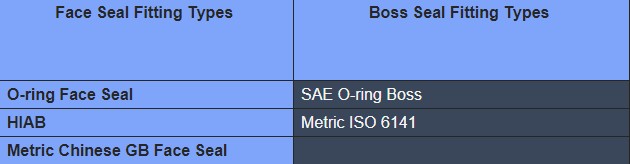
An encapsulated O-ring is used to make a seal by both the Face Sealing and Boss Sealing fitting types. The O-ring in Face Seal fittings is situated in the groove at the male thread’s tip, whereas the O-ring in Boss Seal fittings is located at the male thread’s base. When the fittings are screwed together, the female Face Seal fitting with the matching male fitting engages the male fitting’s O-ring and compresses it, forming a seal. Female fittings with a boss seal, on the other hand, have a grooved “boss” before the first thread that serves to enclose the male thread’s O-ring and therefore create a seal.

Parallel vs. Tapered Threads
When working with a port fitting, the first step in thread identification is to decide whether the thread is parallel or tapered. When the thread walls are parallel, they are straight; when they are tapered, they would ultimately meet if the thread were to be extended longitudinally. For port applications, all parallel fittings must have a seal.

This initial step will assist you in ruling out many potential thread kinds and describe the sealing procedure. The fitting will often use an O-ring or seal to seal the top of the thread for a parallel thread in a port application. When the threads are tapered, the fitting usually seal by wedging the threads into the metal. Although many factors are at play, it is also conceivable for some tapered males to thread into specific parallel female threads. Before installation, a thread sealer may be used to lessen the likelihood of leaking on tapered threads.

Ball vs. Cone vs. Flared Seat
An advantage to overall fitting identification recognizes seats, chamfers, and their related angles. The term “flared seats” describes the interior flare of a female thread or the projecting “nose cone” on a male thread. However, when we talk about “ball seats,” we mean the nose cone in a female thread (only swivel) that seals with the bevel or chamfer inside a male thread. This type of seal is made between the flared seats or, as in the case of the last example, between the chamfer and ball seat, in contrast to previously stated sealing techniques.


24° Metric Compression Fittings
Most metric threads offered by Hydraulics Direct are referred to as “dual purpose,” which means they may be used for port and tube applications. This also applies to Kobelco fittings, which are basically L-series metric threads in all sizes with a 1.5mm thread pitch. A 24° tapered throat angle occurs inside the male threads of most metric and Kobelco threads, making them suitable for tube application. A ferrule or cutting ring must grab the tube to create a tube connection. Therefore, a tube nut is tightened over the metric threads. The ferrule squeezes the tube and holds it in place by tightly tightening the nut.


How to determine Hydraulic Fitting Angle
The Angle is among the most crucial considerations when selecting the ideal replacement fitting for your hydraulic system. 45° and 90° angles are the most popular. On elbow fits, though, you could occasionally confront 22.5° angles. To calculate the fitting’s Angle, use a protractor.
It’s crucial to keep in mind that wear and tear might have significantly altered the proportions while measuring the old fitting. If the measurements of your old fitting don’t line up with the charts, it’s crucial to get a professional opinion on fitting size.
Common Hydraulic Fittings in the Market
The three variables of size, configuration, and thread types will affect the types of hydraulic fittings. The O-ring, the mated Angle, and the tapered thread connectors are the three most typical fitting ends and connector types for hydraulic fittings. Several more varieties are utilized in various specialized applications, even though these are the most often employed options.
Tapered Thread
There are two different kinds of taper thread fittings: male and female. Female fitting threads are inside, and male fitting threads are on the outside. When the two are threaded together, the deformed tapered threads exert pressure on the couplings, forming the seal. Although tape should never be used to maintain the seal, tapered threads tend to be inaccurate.
O-ring
All gadgets are sealed with O-rings to keep them functional and secure. They do this by 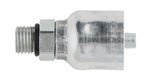 preventing impurities and undesirable fluids from entering hydraulic systems. An O-ring seal is a primary element in generating the seal with these connections. O-ring boss, flat face O-ring seal, and O-ring flange are the three types of O-ring seal designs. They do this by preventing impurities and undesirable fluids from entering hydraulic systems. An O-ring seal is a primary element in generating the seal with these connections.
Mated Angle (cone seat)
One example of a mated angle is SAE 45° or JIC 37°. However, there are others as well. For Sealing, angle seat fittings use parallel or straight threads. The threads do not create the seal when the male and female equivalents are threaded together. Instead, when the two matching angle seats are put together, a seal is made.
What Hydraulic Fitting is Best (Applications)
Call Sinopulse for assistance if you’re looking for hydraulic fittings that must be of the highest caliber and effectiveness. You may get the best hydraulic fittings from Sinopulse for your next application.
Metric Din Fittings
Metric din fittings are the best option when dealing with a compatibility issue. These fittings are well-known for being widely used globally and have the capacity to satisfy high standards of quality. These fittings guarantee excellent reusability and seal. Hydraulic fittings for metric tubing can be used with metric din tubing.
O-Ring Face Seals
O-ring face seals are frequently used in hydraulic lines on off-road vehicles like tractors, combines, and other large pieces of construction machinery. These fittings are suitable for industrial or commercial applications and are available in plated or stainless-steel composition to resist excessive corrosion. It is crucial to minimize or eliminate all potential leak spots and instances of leakage since off-road vehicles frequently vibrate and activate their components.
Stainless Steel Hydraulic Fittings
This hydraulic fitting of the AISI 316 standard is suitable for dependable and long-lasting operation. These fittings are resistant to dust and rust and may be used for various tasks, such as food processing, fertilizer applications, saltwater mist, etc.
Hydraulic fittings made of stainless steel are appropriate when sanitary protection is needed to prevent fluid wastage. You can connect with no leaks thanks to Mechanical Power’s high-quality hydraulic fitting.
JIC Fittings
The hydraulic fittings with a 37-degree cone and the ability to connect to a hose or tube are known as JICs. It is ideal for all hydraulic applications and can save your equipment under challenging situations. This answers all your business needs for hose fittings, hydraulic line hose ends, and hose assemblies.
Brass Hydraulic Fittings
When it comes to employing them in hydraulic and automotive operations, brass hydraulic fittings are renowned for their durability. These require little maintenance and have excellent corrosion resistance. To meet current regulations, we have you covered everything from bend fittings to hose fittings.
Brass hydraulic fittings are durable for an extended period without experiencing environmental deterioration, thanks to their stringent quality requirements. These fittings are suitable for automotive applications since they are low-pressure.
Conclusion
It’s crucial to keep in mind to check your hoses and fittings every few months for leaks and a tight connection. If chosen incorrectly, even new fittings might result in issues. Even though selecting a hydraulic fitting might sometimes be confusing, if you follow us through this article, you should know how to identify hydraulic fitting.